On May 1919, in order to verify the predictions of the general relativity, Frank Dyson and Arthur Eddington organised an experiment. During a total solar eclipse, two expeditions, one in Africa and the other one in South America, observed a group of stars, which light passed near the sun on its way to Earth. Later that day, at night, they observed the same group of stars, and they realised that its position was not the same in the sky as before.
This was not a surprise, the results the images showed indicated that Einstein’s theory was correct, replacing Newton’s model. Why?
The experiment was very simple: according to general relativity predictions, the light, as a particle with mass, would modify its trajectory to the Earth while passing nearby the sun, affected by the big star’s curvature of the space. Newton’s theory also implicated this deflection, but much smaller.
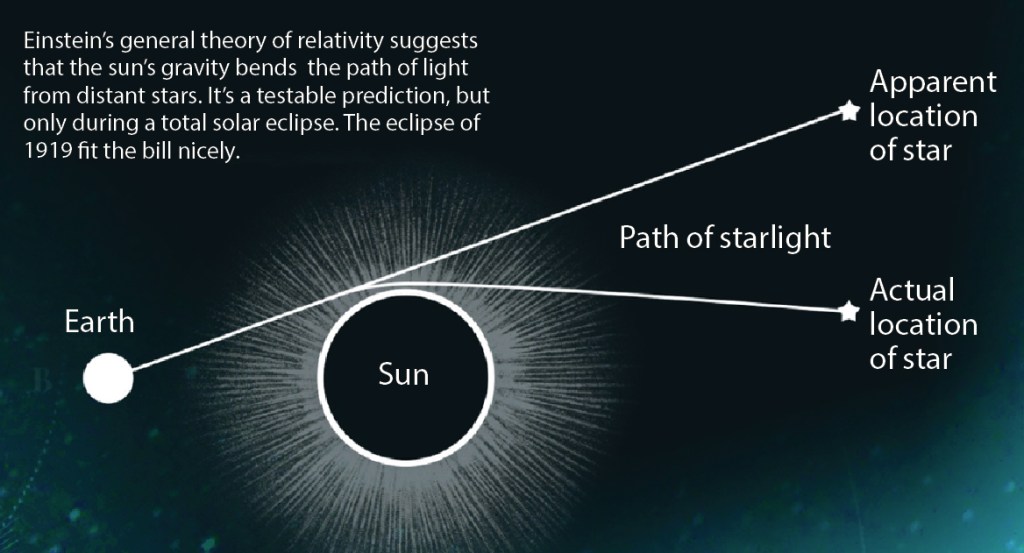
This could only be seen during an eclipse because at night the sun’s mass would not be in the way of the starlight. So, from Earth we could see a star, but its real position would not be that, because the light would had modified its trajectory. This was only possible thanks to Einstein’s theory, and this work represented the global acceptation of the general relativity.
 SUMMER NEWS BLOG